Nikon Z50II: Nikon's current DX all-rounder, explained
Nikon's current DX Z-mount body, which replaced the Z 50. Launched at $909.95 in 2024 (body only). Who it suits: first-time and step-up buyers who want strong autofocus and video in a small body.
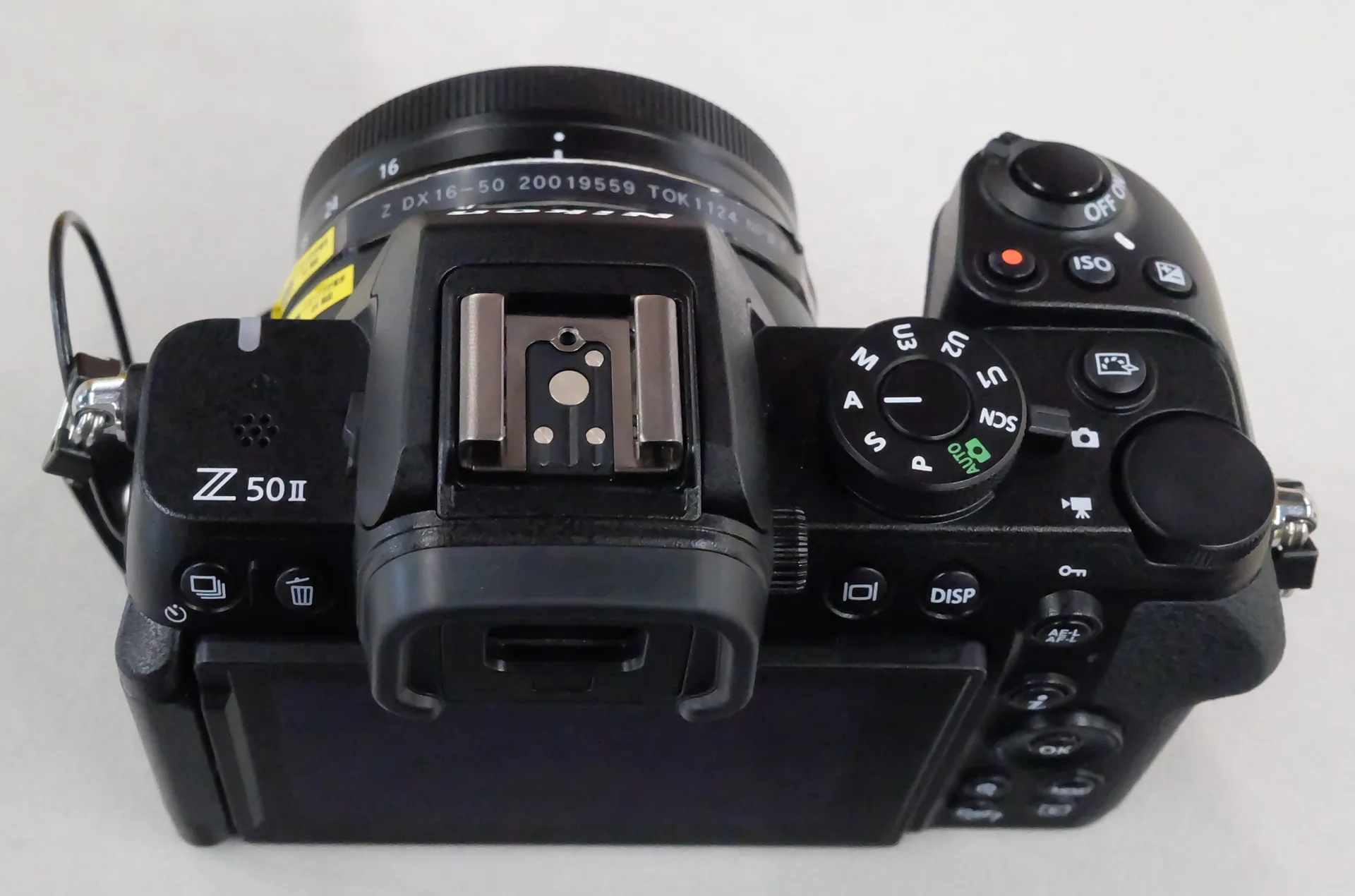
Nikon Z50II, top view of a store display unit with a kit zoom (lens not included with the body). Photo: 昼落ち via Wikimedia Commons, CC0 (resized)
HIGHLIGHTS
Why it exists. Nikon pitched the Z50II as combining "fun imaging features with the superior functions and performance of higher-end models", easy enough for first-time camera users. It uses the same EXPEED 7 engine as the flagship Z9, with the same nine types of subject detection, and adds a Picture Control button, "installed for the first time in the Nikon Z series", for Nikon's color looks and downloadable Imaging Recipes. It replaced the Z 50 as Nikon's main DX Z-mount body.
Nikon Inc. announced the Z50II on November 7, 2024 at $909.95 body-only, for late November 2024. The sensor is the 20.9MP DX chip from the Z 50; around it, Nikon added AF down to −9 EV (with an f/1.2 lens), 30 fps High-Speed Frame Capture+ with Pre-Release Capture, a fully vari-angle 3.2-inch touchscreen, 4K UHD up to 60p with 4K/30p oversampled from 5.6K, N-Log and HLG, a headphone jack, USB streaming (UVC/UAC) and a UHS-II card slot. It keeps a pop-up flash and the 1.02x OLED finder.
Our gallery comes from six photographers: a lone tree in fog, a little egret with its breeding crest, wheat and chamomile in Belgium, the view over Ishinomaki from Mt. Hiyoriyama, a metro train at ISO 12800 and the Cojímar tower near Havana. Who should buy it? Buyers who want subject-detection AF and modern video in a small DX body. The costs: about 550 g with battery and card, about 230–250 shots per charge (CIPA), and no in-body stabilization.
The story
Nikon announced the Z50II on November 7, 2024, using "the same EXPEED 7 image-processing engine used by our flagship camera, the Nikon Z9" and "the same nine types of subject detection as our flagship model" (Nikon).
Nikon Inc. said it would be "available in late November 2024 for a suggested retail price of $909.95 for the body only", with one-lens and two-lens kits at $1,049.95 and $1,299.95 (Nikon Inc. via PR Newswire).
Key specs for the Nikon Z50II, from the Z50II online manual (Specifications and Battery endurance), Nikon's November 7, 2024 announcement and Nikon Inc.'s US release. Source for each row in brackets.
100–51200; expandable to ISO 204800 equivalent [Nikon manual]
Autofocus
Hybrid AF, 209 points (single-point) / 231 (auto-area); nine subject-detection types; −9 to +19 EV (f/1.2 lens) [Nikon manual, Nikon]
Stabilization
No sensor-shift stabilization listed; electronic VR for movies; lens VR [Nikon manual]
Bursts
About 11 fps (continuous high-speed, extended); 15 or 30 fps High-Speed Frame Capture+ with Pre-Release Capture [Nikon manual, Nikon]
Shutter / flash
1/4000–30 s (extendable to 900 s in M); built-in pop-up flash, guide number about 7 (m, ISO 100); hot shoe [Nikon manual]
Viewfinder
0.39-inch OLED, about 2,360k dots, about 1.02x [Nikon manual]
Screen
3.2-inch vari-angle touchscreen, about 1,040k dots [Nikon manual]
Video
4K UHD up to 60p; 4K 30/25/24p oversampled from 5.6K; Full HD up to 120p; H.265 10-bit, N-Log and HLG [Nikon manual, Nikon]
Card / ports
One SD (UHS-II); USB-C; HDMI Type D; mic input and headphone/remote jack; USB streaming (UVC/UAC); Wi-Fi and Bluetooth [Nikon manual, Nikon Inc.]
Battery
EN-EL25a: about 230–250 shots (monitor) / 220–240 (viewfinder), CIPA, depending on energy-saving settings [Nikon manual]
Size / weight
127 × 96.8 × 66.5 mm; about 550 g with battery and card (495 g body only) [Nikon manual]
Announced / price
Nov 7, 2024; $909.95 body-only (US) [Nikon, Nikon Inc.]
Sample photos
Six photos taken with the Nikon Z50II by six photographers, shared on Wikimedia Commons under Creative Commons licenses or in the public domain. Each caption gives the settings the file records. Select a photo to enlarge it. More samples from Wikimedia Commons
f/7.1, ISO 100, 1/125 s, 135mm: a lone tree in fog in the Orlické hory, Czechia (NIKKOR Z DX 50-250mm f/4.5-6.3 VR). Photo: Ted Moravec via Wikimedia Commons, CC0 (resized)f/8, ISO 640, 1/500 s, 280mm: a little egret with its breeding crest (NIKKOR Z 28-400mm f/4-8 VR). Photo: Kjoonlee via Wikimedia Commons, CC BY 4.0 (resized)
f/10, ISO 100, 1/400 s, 48mm: wheat and chamomile at the Kalkense Meersen, Belgium (NIKKOR Z DX 18-140mm f/3.5-6.3 VR). Photo: DimiTalen via Wikimedia Commons, CC0 (resized)f/7.1, ISO 100, 1/400 s, 50mm: the view north over Ishinomaki from Mt. Hiyoriyama, Japan (NIKKOR Z DX 16-50mm f/3.5-6.3 VR). Photo: 石巻敎祖 via Wikimedia Commons, CC BY-SA 4.0 (resized)
f/5, ISO 12800, 1/125 s, 98mm: an A10 train at Xunfenggang Station, Guangzhou Metro (NIKKOR Z DX 50-250mm f/4.5-6.3 VR). Photo: Tim Wu via Wikimedia Commons, CC BY-SA 4.0 (resized)f/8, ISO 100, 1/500 s, 47mm: the Cojímar tower near Havana (NIKKOR Z DX 18-140mm f/3.5-6.3 VR). Photo: Fraganda via Wikimedia Commons, CC BY-SA 4.0 (resized)
Nikon: Launched at $909.95 in 2024 (US suggested retail, body only).
Verdict
Who it's for: first-time and step-up buyers who shoot family, pets, birds or video and want subject detection, 4K/60p and a vari-angle screen in a small Z-mount body.
Look elsewhere if you want physical shutter and ISO dials and a slimmer body (the Z fc), or in-body stabilization, which neither DX Nikon has.