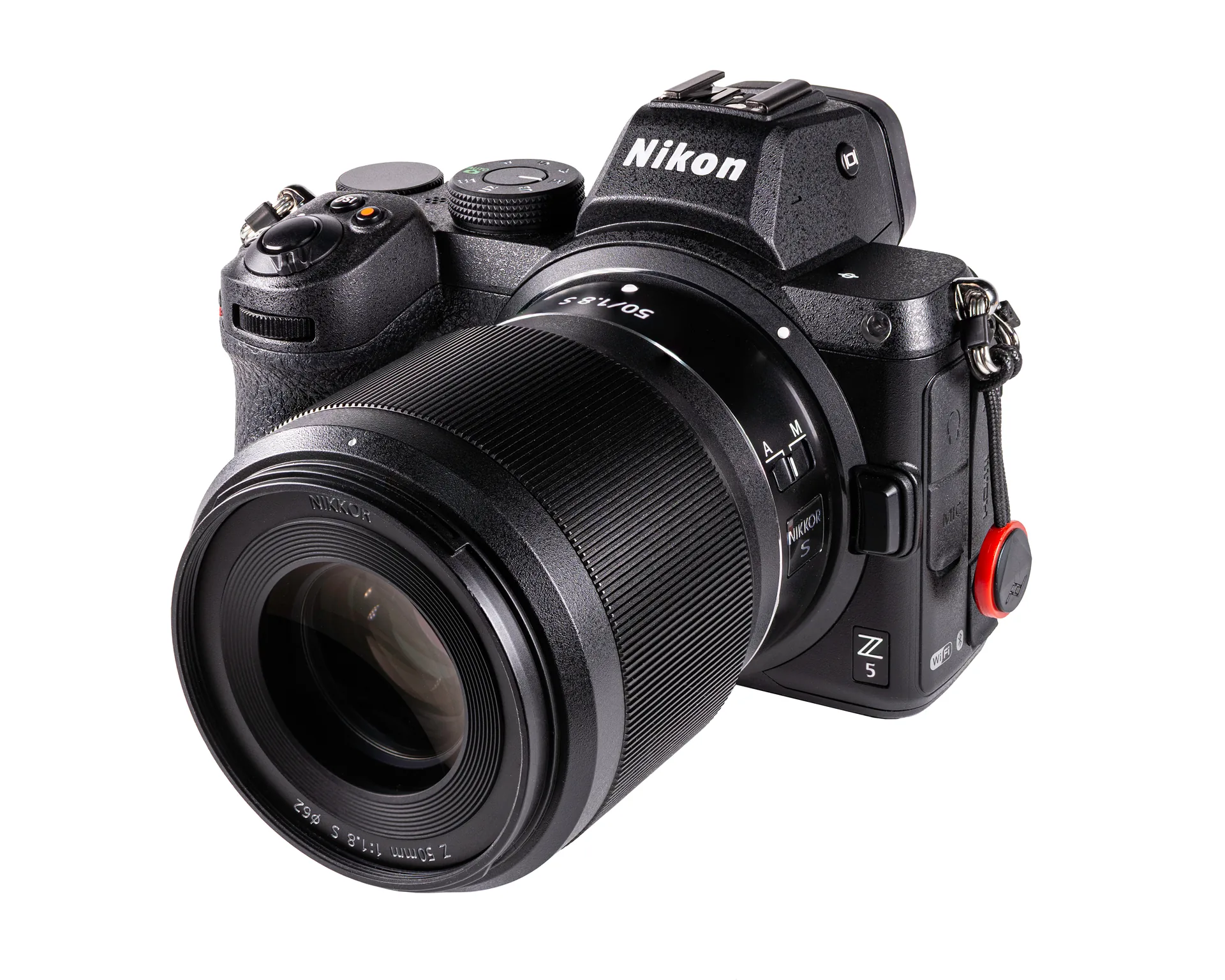
Nikon's entry-level full-frame Z body, still in Nikon's lineup next to the Z5II. Launched at $1,399.95 in 2020, body only. Still worth it in 2026: yes, for stills, travel and landscapes.
Nikon Z5, shown with the NIKKOR Z 50mm f/1.8 S (not included with the body). Photo: Alex 'Florstein' Fedorov via Wikimedia Commons, CC BY-SA 4.0 (resized)
HIGHLIGHTS
Nikon announced the Z5 on July 21, 2020 as the new entry point to its full-frame mirrorless line, at $1,399.95 body-only. It uses a 24.3MP FX-format sensor with EXPEED 6 and a 273-point hybrid AF system with Eye- and Animal-Detection. Five-axis in-camera VR is rated at 5.0 stops, the 3.69M-dot OLED viewfinder runs at 0.8x, and the 3.2-inch screen tilts and responds to touch.
Why it exists. The Z5 was Nikon's way to bring full frame to more buyers without dropping the basics: Nikon gave it a weather-sealed magnesium alloy shell and, unusually for an entry body, two UHS-II SD slots, plus USB power delivery and the bigger EN-EL15c battery. Its limits are in Nikon's own specs: 4.5 fps bursts, and 4K/30p cropped about 1.7x. Nikon Japan still lists it alongside its Z5II successor.
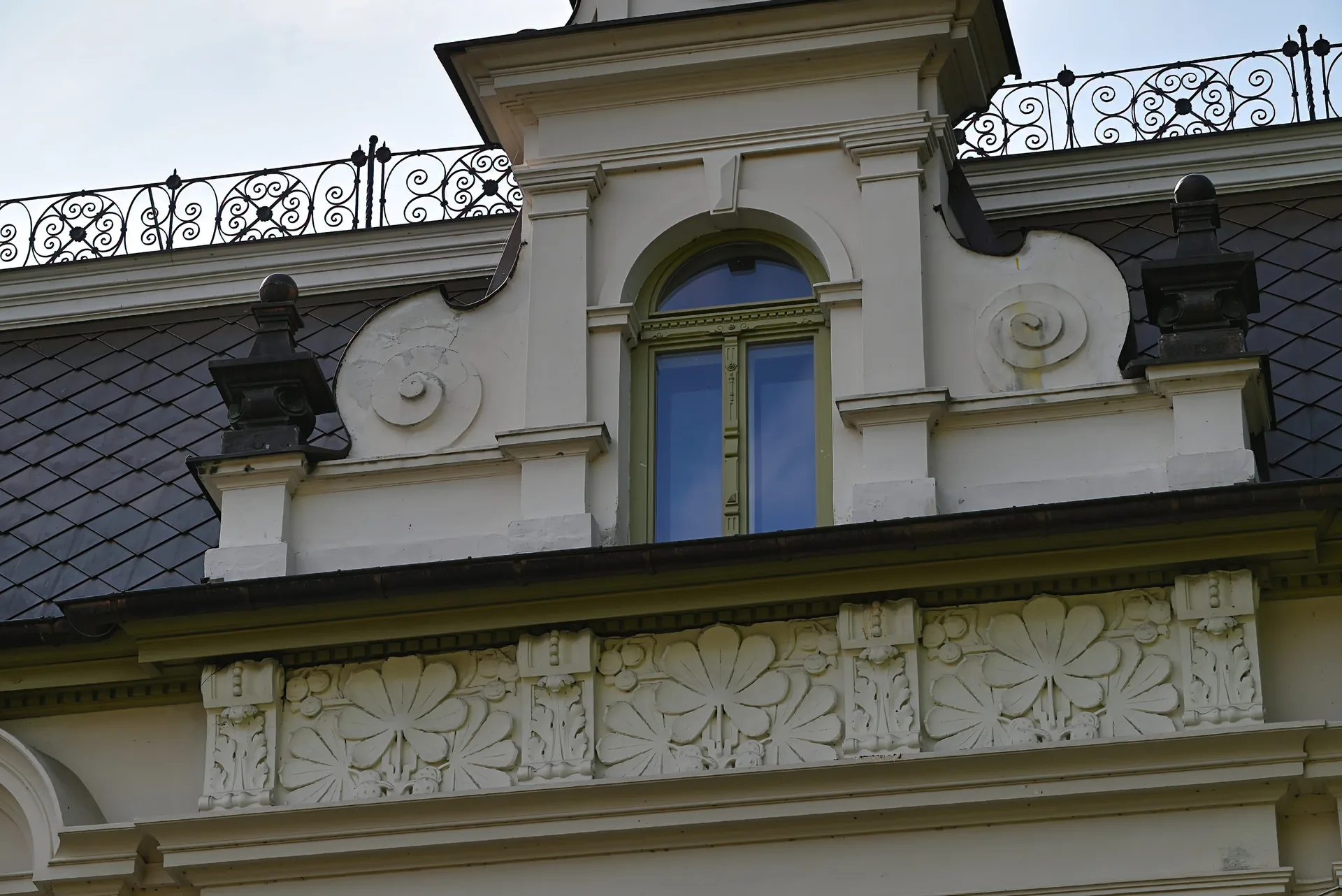
Our gallery comes from five photographers: a frosty morning on Crete's Lasithi Plateau, common puffballs, rocks at L'Agulhas, a pylon corridor at sunrise, the façade of Buchholtz Palace in Supraśl and a stripe-eyed lagoon fly at macro distance. Still worth it in 2026? Yes, for stills, travel and landscape shooters who want full frame with in-body VR and two card slots. Action and video shooters should look at the Z6.
The story
Nikon Inc. announced the Z5 on July 21, 2020, saying it would be available in August for a suggested retail price of $1,399.95 body-only, $1,699.95 with the NIKKOR Z 24-50mm f/4-6.3 or $2,199.95 with the Z 24-200mm (Nikon Inc., via PR Newswire).
The release described the shell as weather-sealed magnesium alloy with the same robustness as the Z 6 and Z 7, and called its constant power over USB a first for Nikon.
Nikon Japan still lists the Z5 in its current mirrorless lineup, alongside the Z5II and Z5IIc (Nikon Japan).
Specifications
Key specs for the Nikon Z5, from Nikon's Z5 product page and Nikon Inc.'s July 21, 2020 release. Source for each row in brackets.
Six photos taken with the Nikon Z5 by five photographers, shared on Wikimedia Commons or Flickr under Creative Commons licenses or in the public domain. Each caption gives the settings the file records. Select a photo to enlarge it. More samples from Wikimedia Commons
f/8, ISO 160, 1/250 s, 24mm: a frosty morning on the Lasithi Plateau, Crete. Photo: Andloukakis via Wikimedia Commons, CC BY-SA 4.0 (resized)ISO 100, 1/60 s: common puffballs (manual lens; aperture not recorded). Photo: Alex 'Florstein' Fedorov via Wikimedia Commons, CC BY-SA 4.0 (resized)
f/6.3, ISO 100, 1/800 s, 120mm: rock formations at L'Agulhas, South Africa. Photo: Roan Fourie via Wikimedia Commons, CC BY-SA 2.0 (resized)f/8, ISO 100, 1/60 s, 52mm: a power-line corridor at sunrise near Rheinzabern, Germany. Photo: Achim Lammerts (Syntaxys) via Wikimedia Commons, CC BY-SA 4.0 (resized)
f/7.1, ISO 160, 1/1250 s, 105mm: the façade of Buchholtz Palace in Supraśl, Poland. Photo: Sylwpak via Wikimedia Commons, CC BY-SA 4.0 (resized)f/13, ISO 125, 1/80 s, 105mm: a stripe-eyed lagoon fly. Photo: Roan Fourie via Wikimedia Commons, CC BY-SA 2.0 (resized)
Nikon: Launched at $1,399.95 in 2020 (US SRP, body only).
Verdict
Who it's for: stills, travel and landscape shooters who want full frame, in-body VR, a good finder and two card slots in a sealed body.
Look elsewhere if you shoot action or video: the Z6 adds 12 fps bursts, full-pixel 4K and Full HD at 120p.