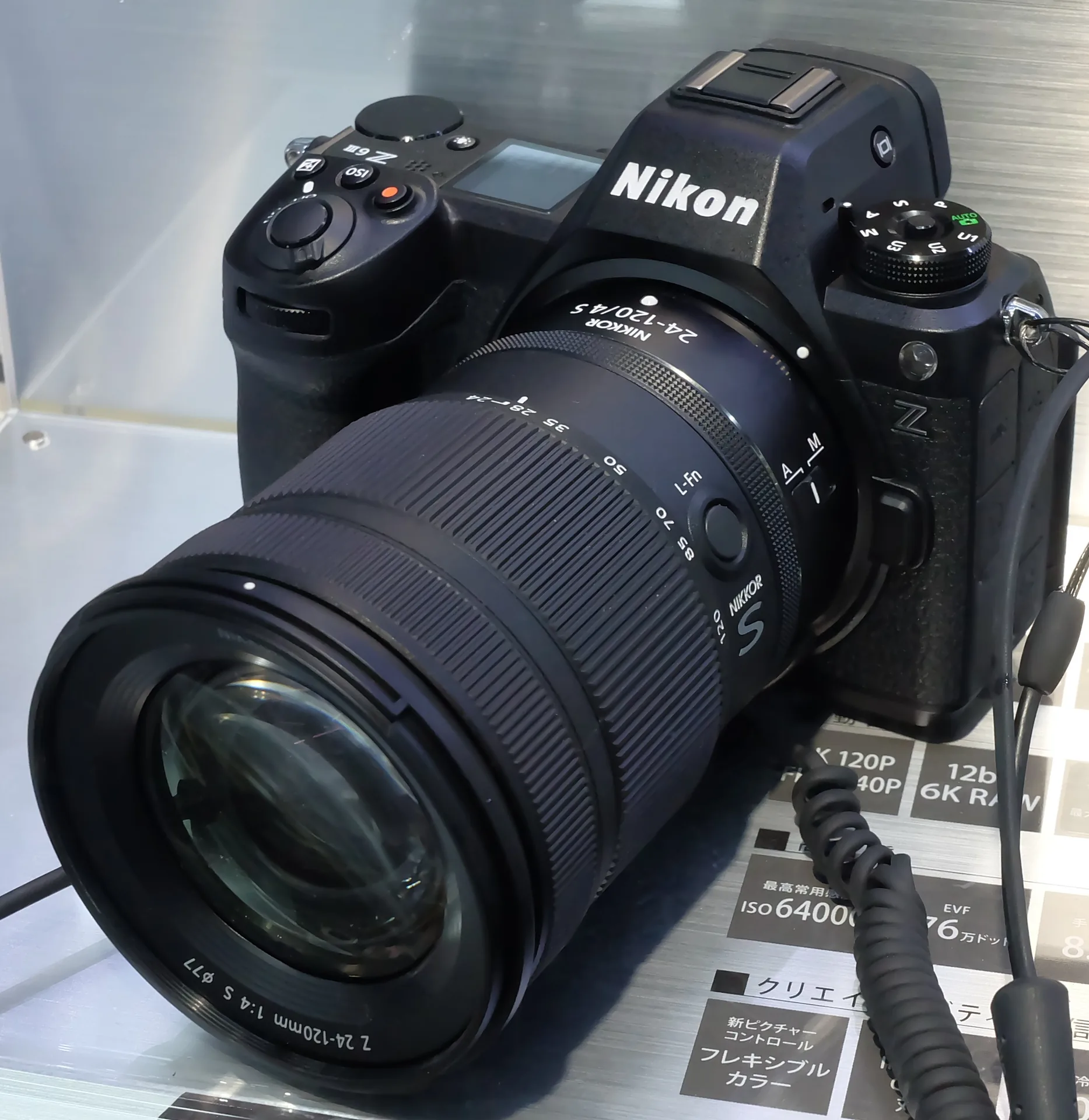
Nikon Z6III on a store display, shown with a zoom lens (not included with the body). Photo: 昼落ち via Wikimedia Commons, CC0 (resized)
HIGHLIGHTS
Nikon announced the Z6III on June 17, 2024, built around a new 24.5-megapixel partially stacked CMOS sensor. Nikon called it the world's first full-frame mirrorless camera with a partially stacked sensor and rates its readout about 3.5x faster than the Z6II's. With the EXPEED 7 processor, it shoots about 20 fps electronically, and Pre-Release Capture at up to 120 fps (JPEG) records frames from before the shutter is fully pressed. AF detects nine subject types and works down to -10 EV.
It's also Nikon's most capable mid-range video camera so far: internal 6K/60p N-RAW and ProRes RAW HQ, 5.4K/60p ProRes 422 HQ and H.265, 4K up to 120p and Full HD up to 240p, with N-Log and HLG. Nikon rates the in-body VR at the equivalent of 8.0 stops. The 5.76M-dot viewfinder reaches 4,000 cd/m², and the 3.2-inch screen is fully vari-angle. Nikon describes its durability as equivalent to the Z8 and rates it for use down to -10°C.
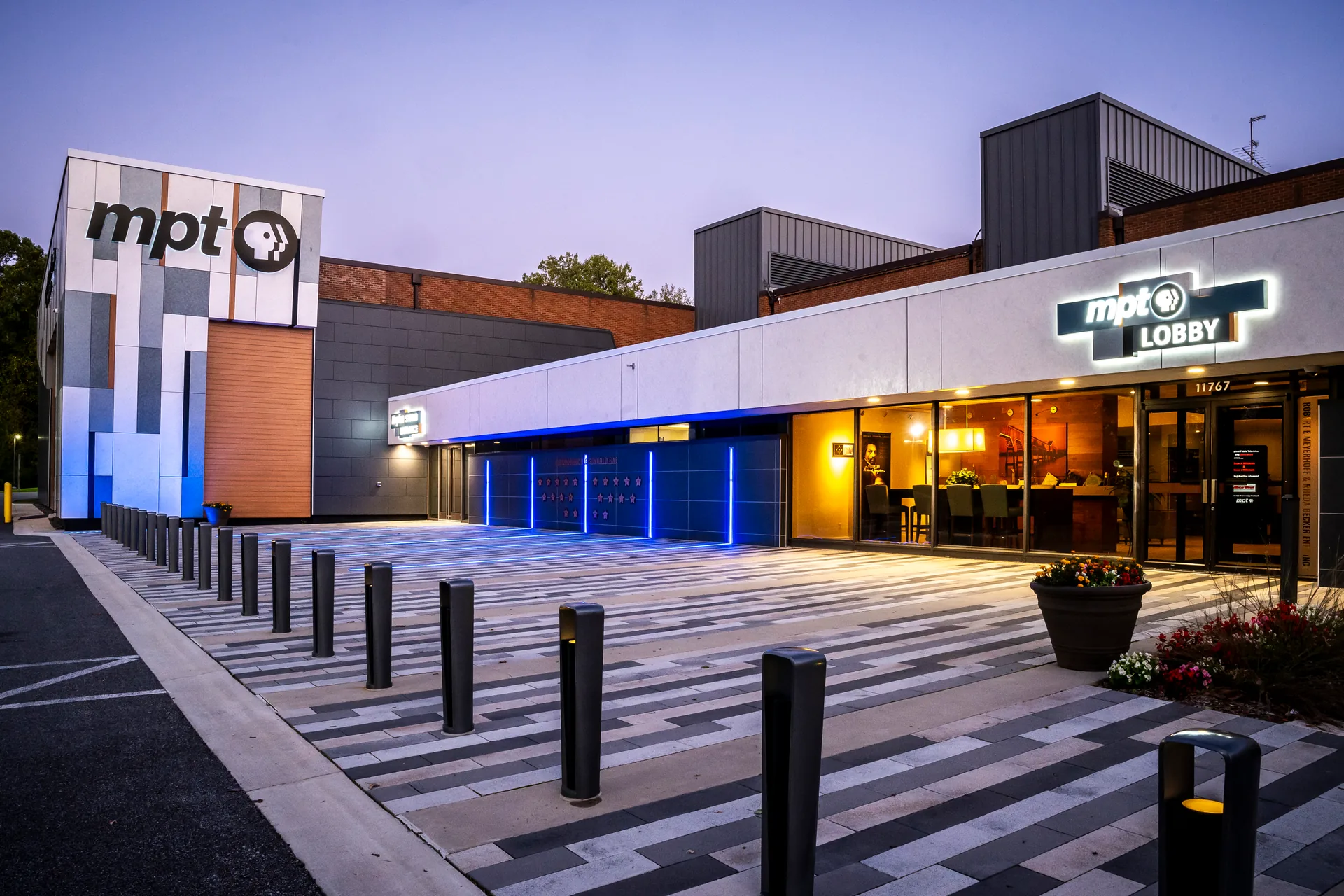
The trade-offs are size and battery: 760 g ready to shoot, 55 g more than the Z6 II, and Nikon's CIPA rating is about 380 viewfinder shots on the EN-EL15c. Our gallery comes from six photographers and covers an aurora, a night cityscape, a kiwi-fruit macro, a construction crane at dawn, a plaza at dusk and a Stockholm landmark. If you don't need the speed or 6K RAW, the Z6 II covers most stills work.
The story
Nikon announced the Z6III on June 17, 2024 (Nikon), at an SRP of $2,499.95 body-only, or $3,099.95 with the NIKKOR Z 24-70mm f/4 S, for availability in late June 2024 (Nikon Inc.).
It replaced the 2020 Z6 II, keeping 24.5MP but moving to a partially stacked sensor and the EXPEED 7 processor from the Z8 and Z9.
Specifications
Key specs for the Nikon Z6III, from Nikon's Z6III product page and online manual specifications and Nikon's June 17, 2024 release. Source for each row in brackets.
Sensor
24.5MP full-frame (35.9 × 23.9 mm) partially stacked CMOS; readout about 3.5x faster than the Z6II [Nikon]
Processor
EXPEED 7 [Nikon]
ISO
100–64000; expandable to 50–204800 equivalent [Nikon]
Autofocus
273 points (single-point) / 299 (auto-area); nine subject types including airplanes; 3D-tracking; -10 to +19 EV [Nikon]
About 14 fps mechanical, 20 fps electronic; C30/C60/C120 with Pre-Release Capture (JPEG) [Nikon]
Video
Internal 6K/60p N-RAW and ProRes RAW HQ (12-bit); 5.4K/60p ProRes 422 HQ and H.265 (10-bit); 4K up to 120p; Full HD up to 240p; N-Log and HLG [Nikon]
Pixel Shift
Composites of about 96MP [Nikon]
Viewfinder
0.5-inch OLED, about 5.76 million dots, 0.8x, up to 4,000 cd/m², DCI-P3 gamut [Nikon]
Screen
3.2-inch vari-angle touchscreen, about 2.1 million dots [Nikon]
Card slots
One CFexpress Type B / XQD, one SD (UHS-II) [Nikon]
Durability
Equivalent to the Z8; operates down to -10°C [Nikon]
Battery
EN-EL15c; about 380 shots (viewfinder) / 410 (monitor), CIPA, energy saving on [Nikon]
Size / weight
138.5 × 101.5 × 74 mm; about 760 g with battery and card (670 g body only) [Nikon]
Announced / price
Jun 17, 2024; $2,499.95 SRP body-only [Nikon Inc.]
Sample photos
Six photos taken with the Nikon Z6III by six photographers, shared on Wikimedia Commons under Creative Commons licenses or in the public domain. Each caption names the lens where the file records it. Select a photo to enlarge it.
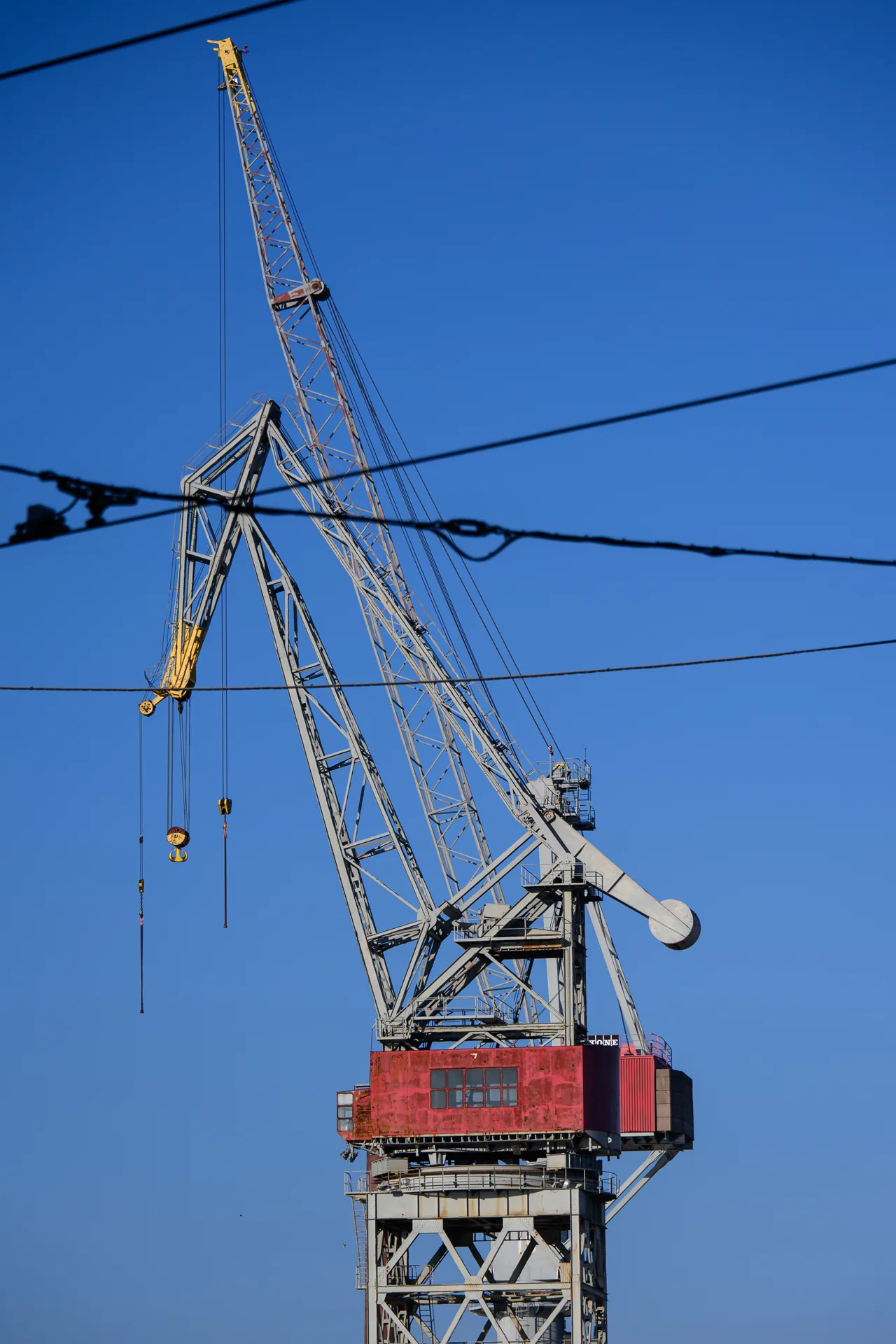
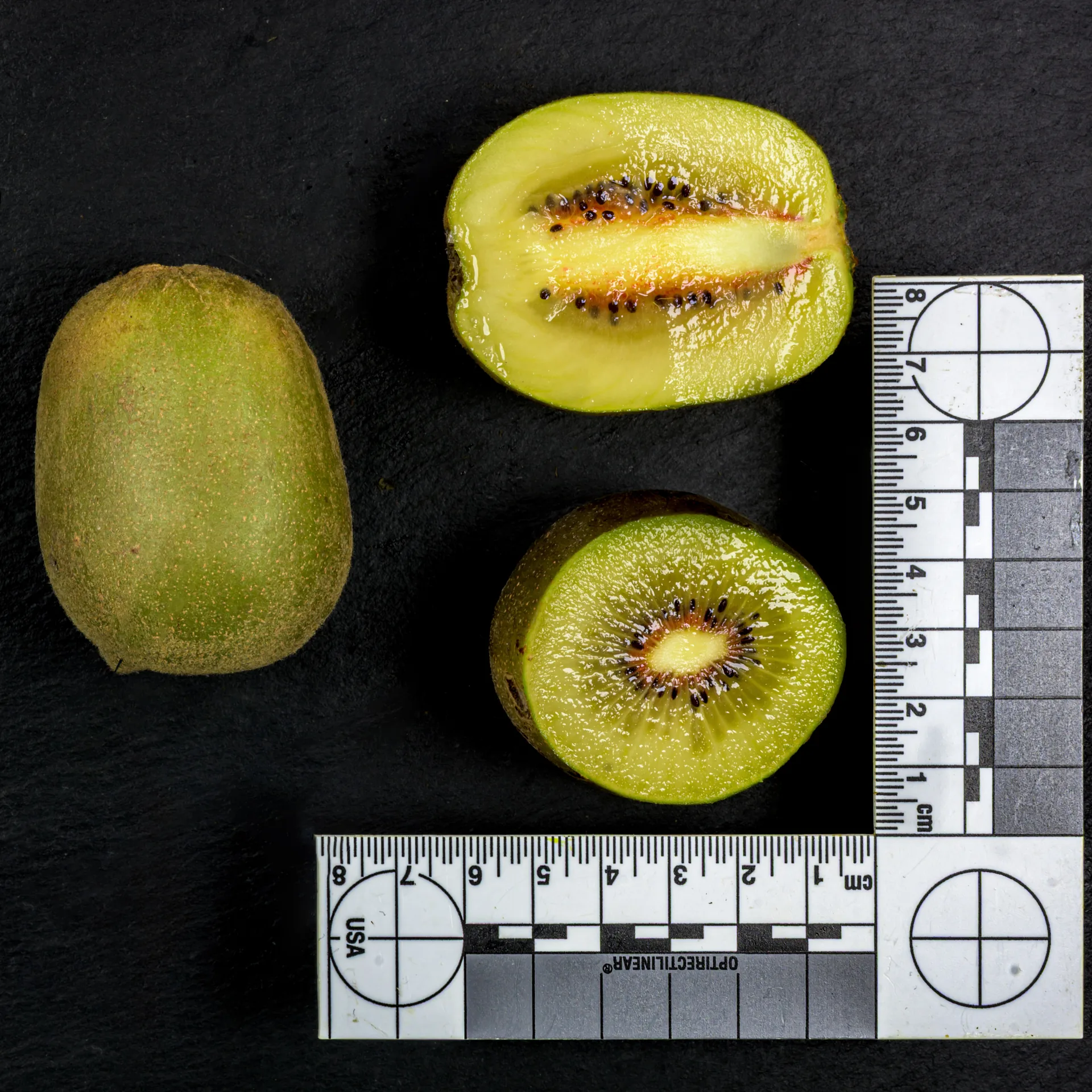
150mm, f/7.1, ISO 100, 1/1000 s: a construction crane in the morning (NIKKOR Z 28-400mm f/4-8 VR). Photo: Henry Söderlund via Wikimedia Commons, CC BY 2.0 (resized)50mm, f/16, ISO 100, 1/6 s: a red-centered kiwi fruit with a scale (NIKKOR Z 50mm f/1.8 S). Photo: Joergens.mi via Wikimedia Commons, CC BY 3.0 (resized)
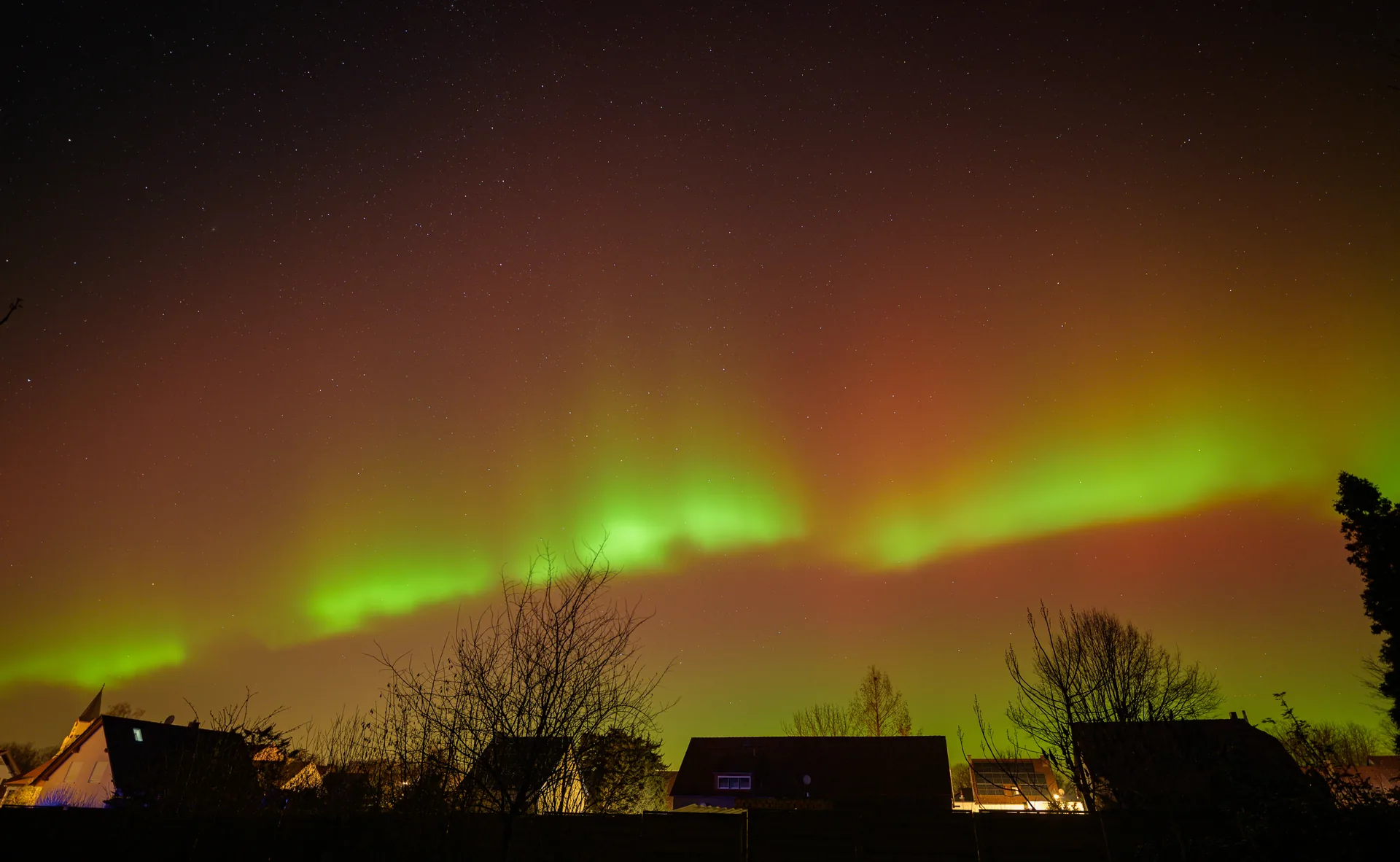
84mm, f/16, ISO 400, 20 s: Xindian, New Taipei, at night (NIKKOR Z 24-120mm f/4 S). Photo: xiangyang17 via Wikimedia Commons, CC BY 2.0 (resized)16mm, f/2.2, ISO 800, 8 s: an aurora over houses (Viltrox AF 16mm F1.8 Z). Photo: Martin Myotis via Wikimedia Commons, CC0 (resized)
24mm, f/13, ISO 1600, 1/13 s: a plaza at dusk (NIKKOR Z 24-70mm f/2.8 S). Photo: Mmac11767 via Wikimedia Commons, CC BY-SA 4.0 (resized)24mm, f/5.6, ISO 140, 1/250 s: the Norstedt building, Stockholm (NIKKOR Z 24-120mm f/4 S). Photo: Frankie Fouganthin via Wikimedia Commons, CC BY 4.0 (resized)
Nikon: Launched at $2,499.95 in 2024 (SRP, body only).
Verdict
The Z6III is the one to buy if you shoot action or video: 20 fps electronic bursts with Pre-Release Capture, nine-subject AF to -10 EV, 8-stop VR, a very bright EVF and internal 6K/60p RAW, at the same 24.5MP as the Z6 II.
Choose the Z6 II instead if you mainly shoot stills and want the lighter body with the same resolution and card slots. Need 45.7MP and 8K? See the Z 8 vs Z6III comparison.