Full Frame vs APS-C: What Sensor Size Really Changes (and What It Doesn't)
A plain-English guide to the two most popular sensor sizes: what the crop does to your lenses, how much cleaner full frame really is in the dark, why background blur changes, and how to pick by what you actually photograph.
October 23, 2026 · Learn
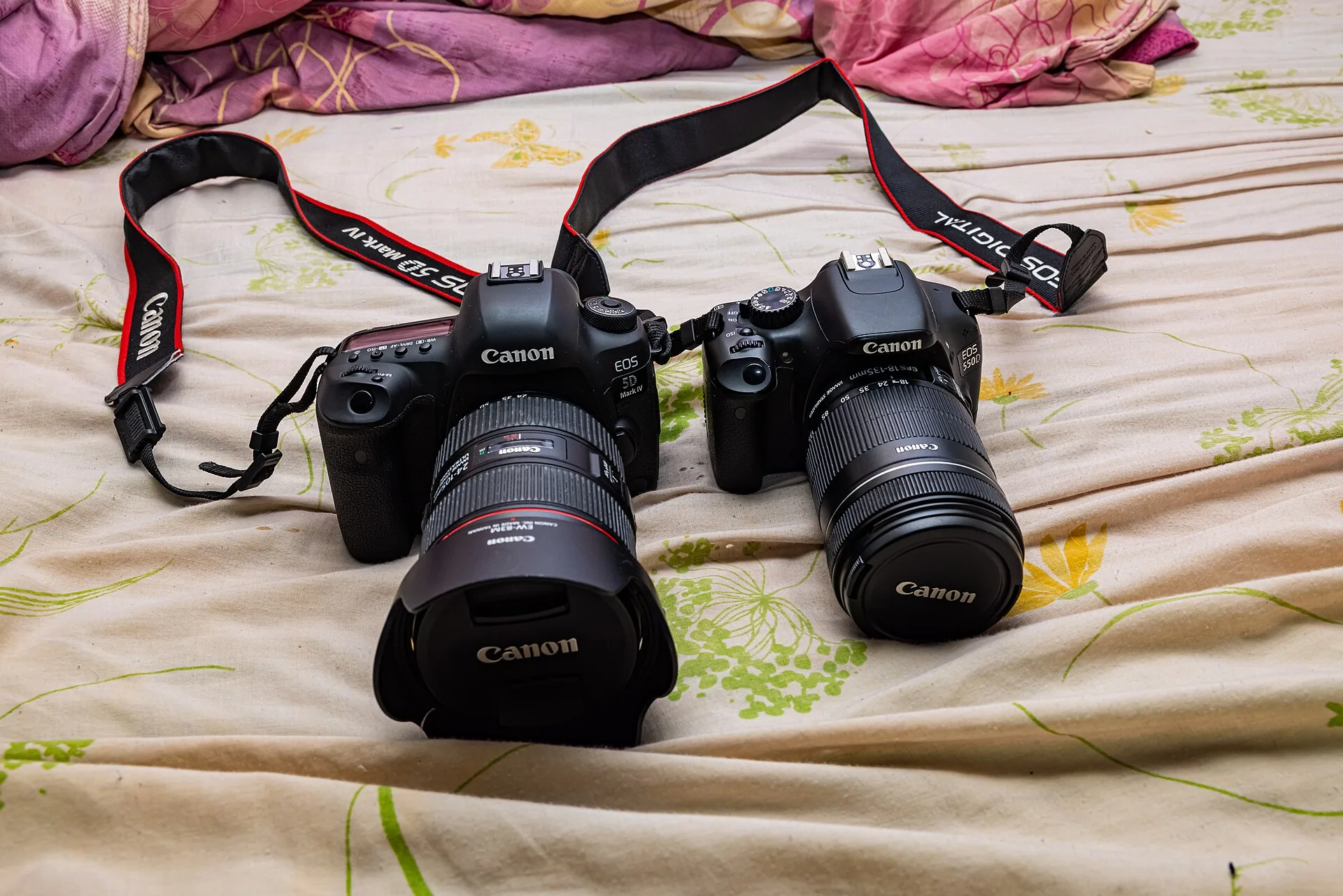
A full-frame Canon EOS 5D Mark IV (left) beside the smaller APS-C EOS 550D. Image: Dinkun Chen via Wikimedia Commons, CC BY-SA 4.0 (resized)
Why this question exists
For most of the 20th century, "a camera" meant a 35mm film camera, and every frame on that film measured 36×24mm. Lens makers, photographers and textbooks all used that frame as the reference point. When someone says a 50mm lens is "normal" or an 85mm is "a portrait lens", they're still talking in 35mm-film terms.
Digital cameras didn't start there. Large image sensors are expensive to make: each one is cut from a silicon wafer, fewer big chips fit on a wafer, and a single defect is more likely to ruin a big chip. So the first affordable digital SLRs used smaller sensors, roughly the size of the "C" frame of the short-lived Advanced Photo System film format launched in 1996 (25.1×16.7mm). That's where the name APS-C comes from. The first full-frame digital SLRs, with sensors matching the old 36×24mm frame, only arrived between about 2000 and 2002, and their much larger sensors were far more expensive to make.
Both sizes stuck. Today you can buy excellent cameras in either format, often from the same brand, on the same lens mount. That's exactly why the question is confusing: two cameras can look almost identical, accept the same lenses and still produce different pictures from the same spot.
Who this guide is for: you're buying your first "real" camera, or you're a phone or APS-C shooter wondering whether full frame is worth the jump. By the end you should know what the sensor size actually changes, how big each difference is in numbers, and which one matters for the photos you take.
The sizes, drawn to scale
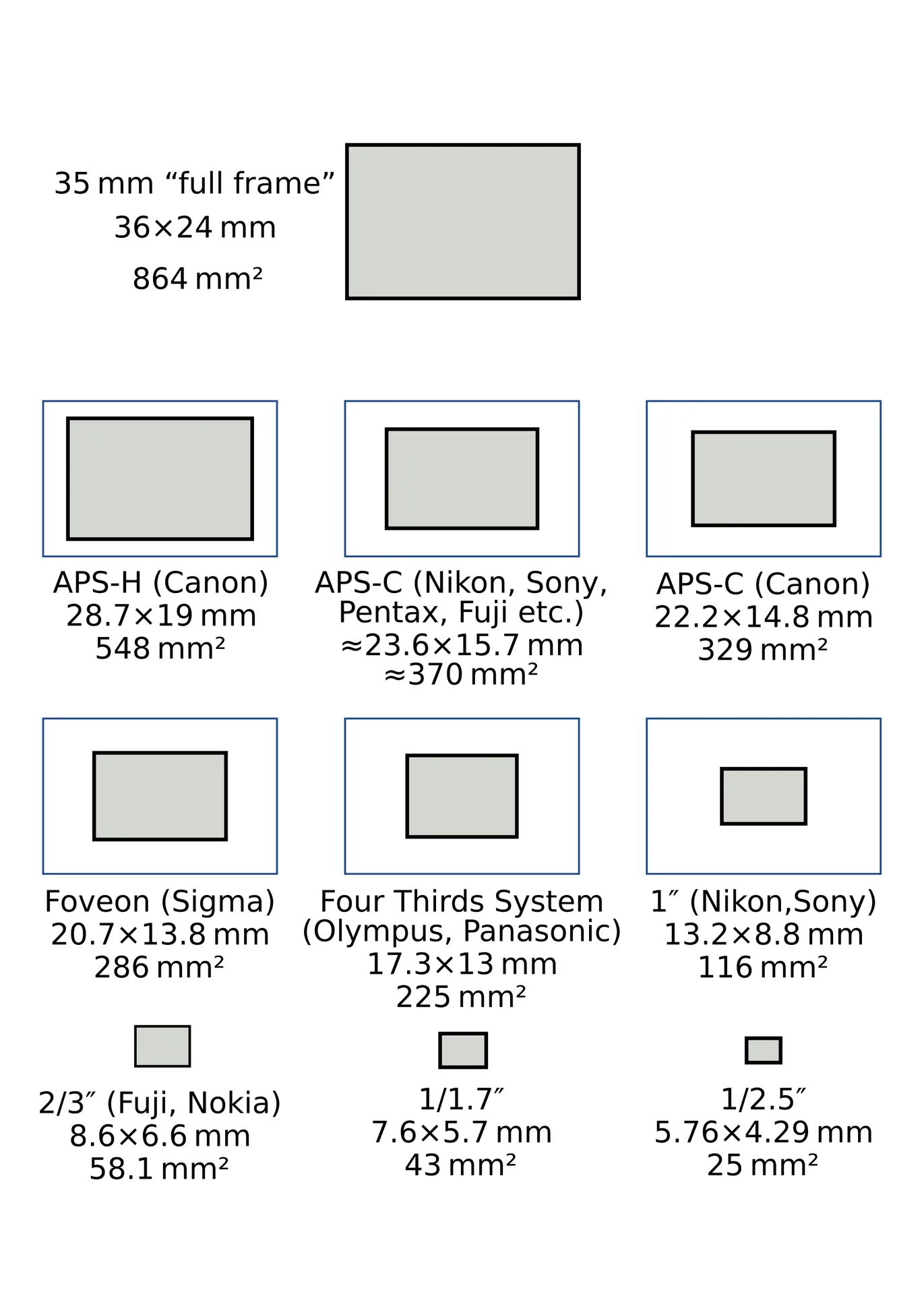
Full frame is 36×24mm (some real sensors measure a hair under, such as 35.9×23.9mm). APS-C isn't one fixed size. Sony, Nikon and Fujifilm APS-C sensors are about 23.5×15.6mm, and Canon's are a little smaller at 22.2×14.8mm. Both keep the same 3:2 shape, so the difference is purely scale.
Work out the areas and the gap is bigger than the side lengths suggest. Full frame is 864 square millimetres. A 23.5×15.6mm APS-C sensor is about 367, and Canon's is about 329. So full frame has roughly 2.4 times the area of Sony-style APS-C and about 2.6 times the area of Canon APS-C. Almost every difference in this guide traces back to that ratio: more area collects more light, and needs a bigger image from the lens.
Full frame
36 × 24 mm · about 864 mm² · crop factor 1.0
APS-C (Sony, Nikon, Fujifilm)
about 23.5 × 15.6 mm · about 367 mm² · crop factor about 1.5
APS-C (Canon)
22.2 × 14.8 mm · about 329 mm² · crop factor 1.6
Common sensor sizes drawn to scale. Full frame and APS-C are the two largest everyday formats. Image: Hotshot977, reworked by Moxfyre via Wikimedia Commons, public domain (rendered from SVG, resized)Our diagram, drawn to scale: the lens projects a circle of light. Full frame records the large rectangle; APS-C records only the middle. The edges simply fall outside the smaller sensor.
Crop factor without the confusion
Picture a printed 8×10-inch photo. Now trim the edges with scissors until you're left with the middle. That's what an APS-C sensor does: it records the centre of the image the lens throws, and nothing else. Enlarge that trimmed print back to 8×10 and the subject looks bigger, as if you'd used a longer lens. That's the whole idea behind "crop factor".
The crop factor is the ratio of the sensor diagonals. Full frame's diagonal is about 43.3mm. Sony-style APS-C comes to about 28mm, so the factor is about 1.5. Canon APS-C is smaller, so it's 1.6.
A worked example. Put a 50mm lens on a Canon EOS R50, which has a 1.6× crop. Multiply: 50 × 1.6 = 80. You get the view an 80mm lens would give on full frame, which is a classic head-and-shoulders portrait framing instead of a "normal" view. Mount that same lens on the full-frame Canon EOS RP, which takes the same RF lenses, and you get the plain 50mm view back.
Going the other way helps when you're shopping. If you love the 35mm look on full frame, divide by the crop: on a 1.5× body you want roughly a 23–24mm lens, and on Canon's 1.6× roughly 22mm.
Lens
On 1.5× APS-C frames like
On 1.6× APS-C frames like
24mm
36mm
38mm
35mm
53mm
56mm
50mm
75mm
80mm
85mm
128mm
136mm
200mm
300mm
320mm
For any other focal length, multiply it by the crop factor to get its full-frame equivalent.
Myth: APS-C makes your lens longer. It doesn't. A 50mm lens is always a 50mm lens. The glass, the perspective from a given spot and the exposure are all unchanged. You've just cut away the edges of the picture. "Equivalent focal length" is shorthand for "the framing you'd get on full frame".
Same scene, two sensors
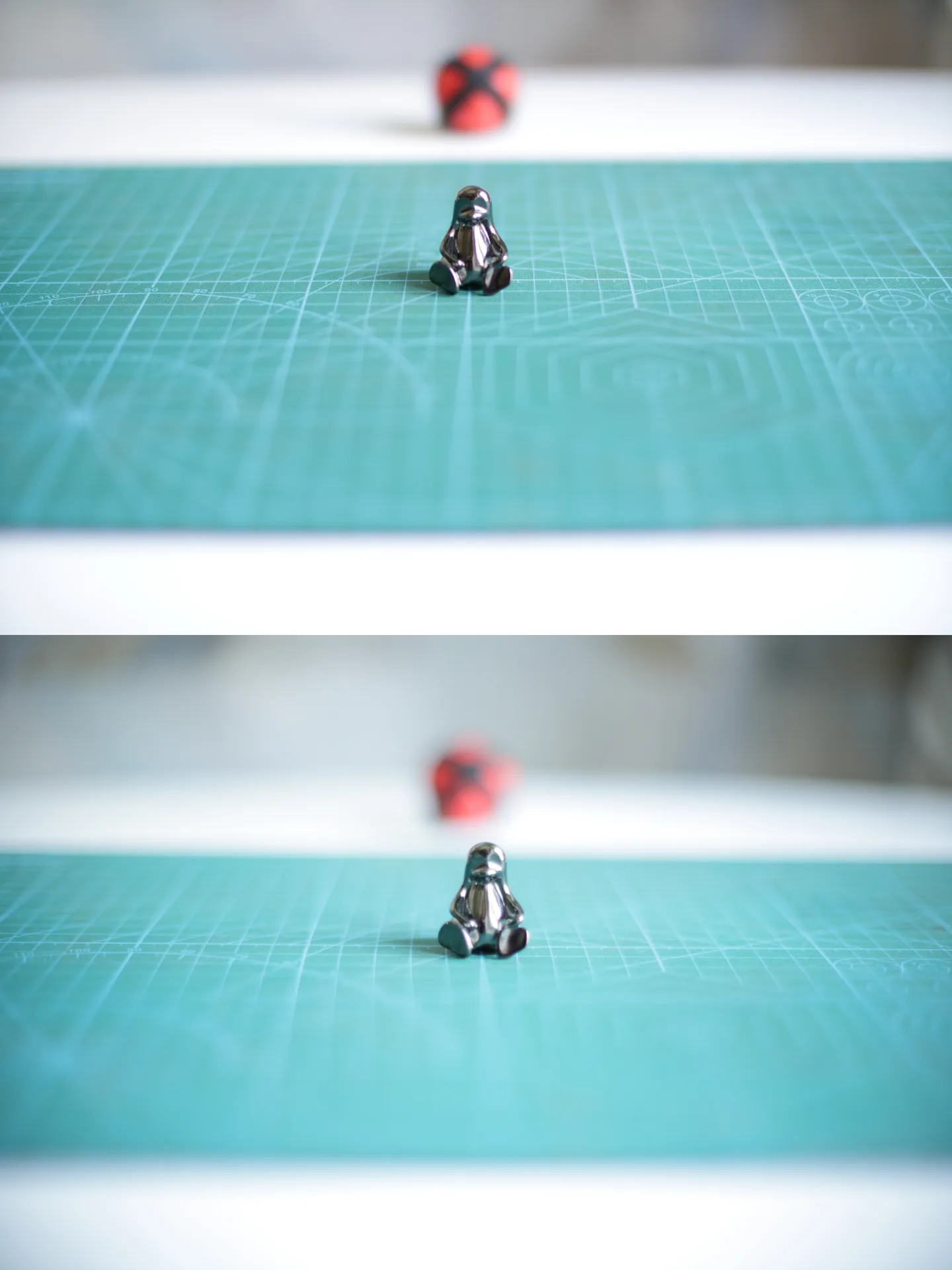
Numbers are one thing, but it helps to see a real pair. The two photos below were shot by the same photographer, of the same little figure on the same cutting mat, from a matching viewpoint. The top one comes from an APS-C Canon EOS M with a 35mm f/0.95 lens. The bottom one comes from a full-frame Canon EOS 5D with a 50mm f/1.2 lens. The lenses were chosen to give almost the same angle of view (43.5° and 46°), which is exactly the crop-factor maths from the last section at work: 35mm on a 1.6× body frames like 56mm.
Look at the red ball behind the figure. Even though the APS-C lens is opened wider, to f/0.95, the full-frame shot melts the ball and the room into a softer blur. Same framing, two sensors, and the bigger one gives shallower focus. The next sections explain why, and why it's also the reason full frame has a low-light edge.
A true same-scene pair. Top: APS-C Canon EOS M, 35mm f/0.95. Bottom: full-frame Canon EOS 5D, 50mm f/1.2. The framing is close, but the full-frame background is softer. Image: Javier Perez Montes via Wikimedia Commons, CC BY-SA 4.0 (resized)
Low light and noise: a little over one stop
Noise is mostly a matter of how much light the whole sensor collects, not just the size of each pixel. Shoot the same scene at the same shutter speed and f-stop, and a full-frame sensor gathers light across about 2.4 times the area of Sony-style APS-C. When you shrink both pictures to the same size on a screen or a print, the full-frame one has more light behind every part of it, so it looks cleaner.
Photographers measure light in stops, where each stop is double or half. Sony-style APS-C gives full frame about 2.4× the area, which works out to about 1.2 stops. Against Canon's smaller 1.6× sensor it's about 2.6×, about 1.4 stops. That's the theory, assuming sensors of a similar generation. Newer sensor designs narrow or widen the gap a little, so treat it as "roughly one stop, a bit more" rather than a fixed rule.
In practice, a full-frame shot at ISO 6400 looks roughly as clean as an APS-C shot somewhere around ISO 2500–3200. That's a useful trade. Indoors at night, it can be the difference between 1/250s, which freezes a child running, and 1/125s, which might not.
Our diagram: total light gathered scales with sensor area. One stop is a doubling, so about 2.4× to 2.6× more area is a little over one stop.
When it matters: receptions and churches where flash isn't welcome, concerts, indoor sports, night streets and astrophotography, where you're already at the limit of shutter speed and aperture. When it doesn't: daylight, golden hour with a steady hand, anything on a tripod where you can use a longer exposure, and photos that will only ever be seen at phone size. At ISO 100–400 on a sunny afternoon, both formats are clean.
Myth: f/2.8 becomes f/4 on APS-C. Not for exposure. f/2.8 lets through the same light per square millimetre on any sensor, so your meter settings don't change. The "equivalent aperture" idea is about depth of field and total light, which the next section covers.
Background blur and depth of field
This is the difference you saw in the same-scene pair. To get the same framing, the APS-C shooter either uses a shorter lens or stands farther back. Both of those deepen the zone that's in focus. So at the same framing and the same f-stop, full frame gives shallower focus and softer backgrounds.
A worked example. A 50mm f/1.8 is the classic budget portrait lens on full frame. To get the same framing and the same depth of field on a 1.5× APS-C body, divide both numbers by the crop factor: 50 ÷ 1.5 ≈ 33mm, and 1.8 ÷ 1.5 = 1.2. You'd need roughly a 33mm f/1.2. On Canon's 1.6× it's about 31mm f/1.1. Lenses that fast exist, but they're rarer, bigger and pricier than a humble 50mm f/1.8. That's the quiet reason portrait and wedding shooters lean full frame.
The same maths runs the other way, and it's not a weakness. A landscape at f/8 on APS-C has about the depth of field of f/12 on full frame, so you get more of the scene sharp without stopping down as far. For macro, where depth of field is razor thin, that extra depth is a genuine help.
Our diagram (illustrative, not to an exact scale): same subject, same framing, same f-stop. The in-focus zone is deeper on APS-C, so backgrounds blur less.
Reach: the APS-C bonus for wildlife and sports
Here APS-C turns the crop into an advantage. A 300mm lens on a 1.5× body frames like 450mm on full frame, and like 480mm on Canon's 1.6×. For birds, distant wildlife and field sports, that's a big step closer without buying, carrying or paying for a longer lens.
The honest caveat: it's still a crop. You aren't magnifying anything; you're putting more pixels on the middle of the frame. A 26-megapixel APS-C sensor such as the Sony a6700's packs its pixels more densely than a 33-megapixel full-frame sensor such as the a7 IV's. Switch the a7 IV to its APS-C crop mode with the same lens and you get the same framing as the a6700, but at about 14 megapixels instead of 26. So the real "reach" gain is pixel density.
Cambridge in Colour puts the weight side bluntly: framing a subject on full frame the way a 200mm f/2.8 does on 1.5× APS-C takes a 300mm f/2.8, which weighs about 3.5 times as much. If you hike to your wildlife, that's the argument for APS-C in one sentence.
Lenses, size, weight and the real cost
A bigger sensor needs a bigger image circle, and that means bigger glass. The body is only the entry fee: the lenses are where full frame really costs you, in grams and in dollars. Here's one realistic pair on Sony's E mount, both constant-f/2.8 standard zooms that cover a similar range once you apply the crop:
Setup
APS-C: Sony a6700 + Sigma 18-50mm F2.8 DC DN
Full frame: Sony a7 IV + Sony FE 24-70mm F2.8 GM II
Framing
like 27–75mm
24–70mm
Body
493 g
658 g
Lens
290 g · 2.4 × 3.0 in
695 g · 3.5 × 4.7 in
Kit
783 g
1,353 g
Body weights include battery and memory card. Lens sizes are diameter × length.
That's about 570 grams more for the full-frame pair, and a lens that's roughly an inch wider and 1.7 inches longer. You'd also be taking on f/2.8 depth of field across a wider equivalent range, so it isn't a like-for-like trade, but it shows the shape of the choice. Over a day of walking, half a kilo is the difference between carrying the camera everywhere and leaving it in the hotel.
Mixing lenses. Full-frame lenses work on APS-C bodies of the same mount, with the usual crop. APS-C lenses also mount on many full-frame bodies: Canon's full-frame EOS R cameras, for example, switch to an APS-C crop automatically with RF-S lenses. You lose resolution in that mode, but it means an APS-C lens collection isn't wasted if you upgrade later.
Check the lens line-up before the body. Some brands have deep APS-C lens ranges; others focus their best new lenses on full frame and leave APS-C buyers leaning on third-party makers. Five minutes on the lens page of the brand you're considering will tell you more than any spec sheet.
Myths, quickly
Myth: more megapixels means full frame. Pixel count and sensor size are separate. A 26-megapixel APS-C camera has more pixels than many older 24-megapixel full-frame bodies. Full frame's advantage is light-gathering area, not a guaranteed pixel count.
Myth: pros only use full frame. Plenty of working wildlife, travel and sports photographers choose APS-C on purpose for the reach and the lighter lenses. What a professional picks is a tool for the job, not a status badge.
Myth: APS-C is just a stepping stone. It can be a destination. A two-day hike with a 783-gram kit is a different trip from one with 1,353 grams. If your photos live in good light and on screens, you may never need anything else.
Myth: full frame is always sharper. Sharpness depends heavily on the lens, focus, shutter speed and technique. A good APS-C lens on an APS-C body beats a soft full-frame zoom, and the crop even skips the corners where many lenses are weakest.
Myth: you'll see the difference in every photo. On a phone screen, in daylight, you almost certainly won't. The gap shows in dim light, in very shallow focus, and in big prints you study up close.
Which should you choose? By what you shoot
Travel and hiking
Lean APS-C. The lighter kit gets carried more often, and the sensor is plenty in daylight. If you shoot a lot of night streets, a fast prime closes much of the gap.
Kids and family indoors
Lean full frame, or put a fast prime on APS-C. Living rooms are darker than they look, and kids don't hold still. Full frame's extra stop buys a faster shutter speed; an f/1.8 prime on APS-C gets you most of the way for less.
Portraits
Lean full frame. Soft backgrounds come easily with an inexpensive 50mm or 85mm f/1.8. APS-C can do it too, but you'll pay more for equally fast glass.
Landscapes and astro
Split decision. Daylight landscapes suit either, and APS-C's deeper focus helps. For the Milky Way, full frame's cleaner high ISO and wide, fast lenses are a real advantage.
Wildlife and sports
Lean APS-C. The crop puts more pixels on a distant subject, and the long lenses you'd need on full frame are heavy and expensive. Indoor sports at night is the exception.
Video
Either. Both formats make excellent video, but some bodies crop the frame at certain resolutions or frame rates. Check the modes you'll actually use, because that crop changes which wide lens you need.
Tight budget
APS-C new, or full frame used. A new APS-C body plus a good lens beats a new full-frame body with a basic one. If full frame is the goal, our best used full frame under $1,000 guide shows what's possible.
"I might upgrade later"
Pick the mount, not just the body. Choose a brand whose APS-C and full-frame cameras share a mount, and buy full-frame lenses where it makes sense. They'll move with you.
Full frame buys you a little over a stop of low-light headroom and easier background blur. APS-C buys you a lighter bag, cheaper lenses and free reach. Neither is the "real" format. Decide which of those trades you'd feel every week, and buy for that.
If you're still unsure, start with APS-C on a mount that also has full-frame bodies. The camera is rarely what holds a photo back: light, timing and practice matter far more. To go deeper, revisit the crop factor section above or see the best used full frame under $1,000.