A plain-English guide to the two camera designs: what the mirror does, what taking it out changed for viewfinders, autofocus, video, battery life, size and lenses, and which one makes sense for you now.
October 23, 2026 · Learn
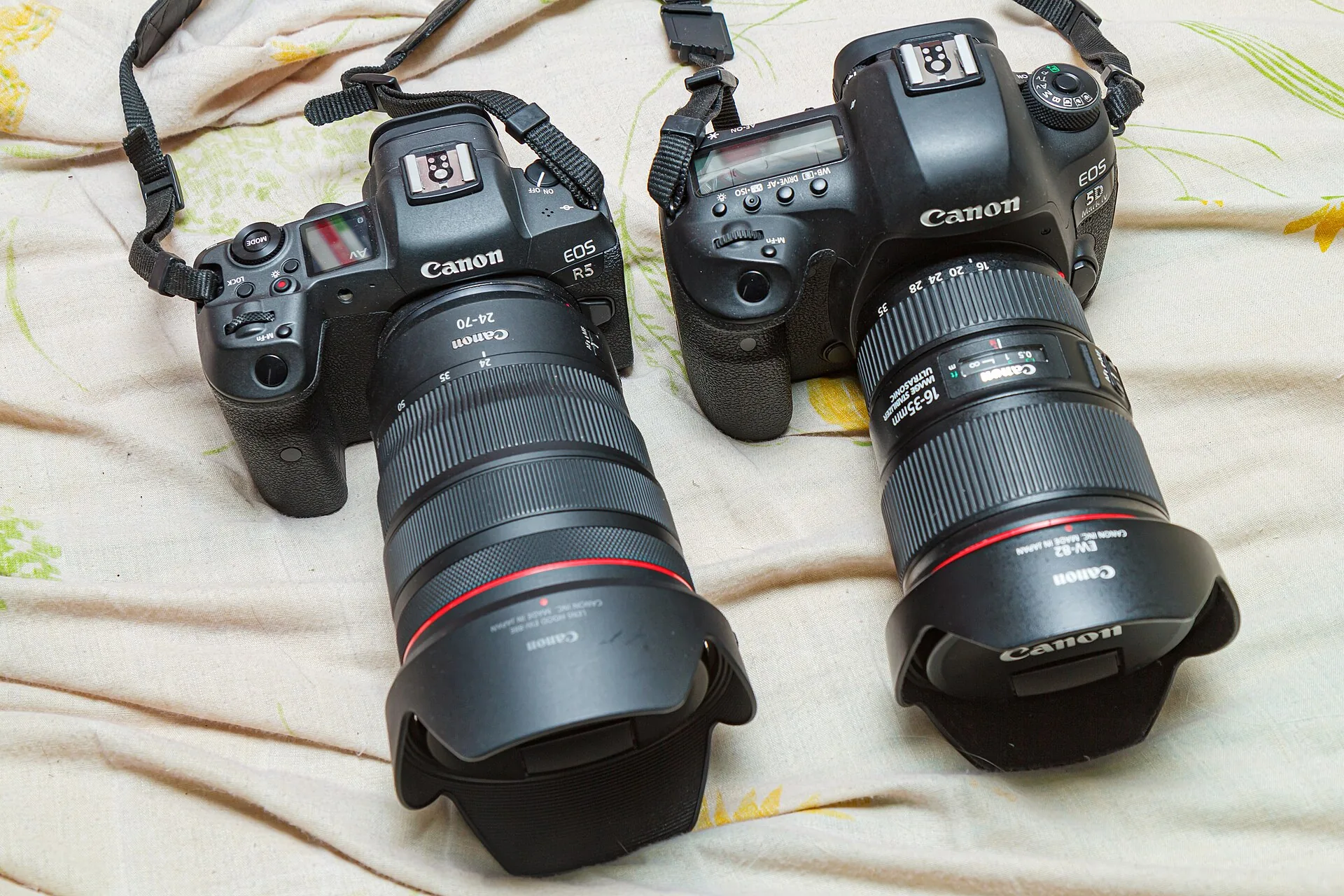
A mirrorless Canon EOS R5 (left) beside a Canon EOS 5D Mark IV DSLR. Image: Dinkun Chen via Wikimedia Commons, CC BY-SA 4.0 (resized)
Why this question exists
For decades, the serious camera was the single-lens reflex, or SLR. Its trick was a mirror behind the lens that sent the image up to your eye, so you saw exactly what the lens saw. When cameras went digital, the design came along unchanged: a digital SLR, or DSLR, is the same idea with a sensor where the film used to be.
Mirrorless cameras take that mirror out. Instead of looking at the scene through glass, you look at a live feed from the sensor, on the rear screen or on a tiny high-resolution display inside the viewfinder. Early mirrorless cameras were small, slow to focus and had laggy finders, so DSLRs stayed the default for enthusiasts and professionals for years.
That has flipped. Sensors now read out fast enough to drive autofocus, tracking and electronic viewfinders that keep up with sport and wildlife. Canon, Nikon and Sony now build their new top bodies as mirrorless cameras, and most new DSLR lines have stopped. Yet DSLRs are still on shelves, still sell, and still take excellent photos. That is why the question keeps coming up.
Who this guide is for: you're buying your first interchangeable-lens camera, you have an old DSLR and wonder whether to switch, or you've seen a cheap DSLR deal and want to know what you'd be giving up. By the end you should know what the mirror actually changes, and which design fits the way you shoot.
How each design works
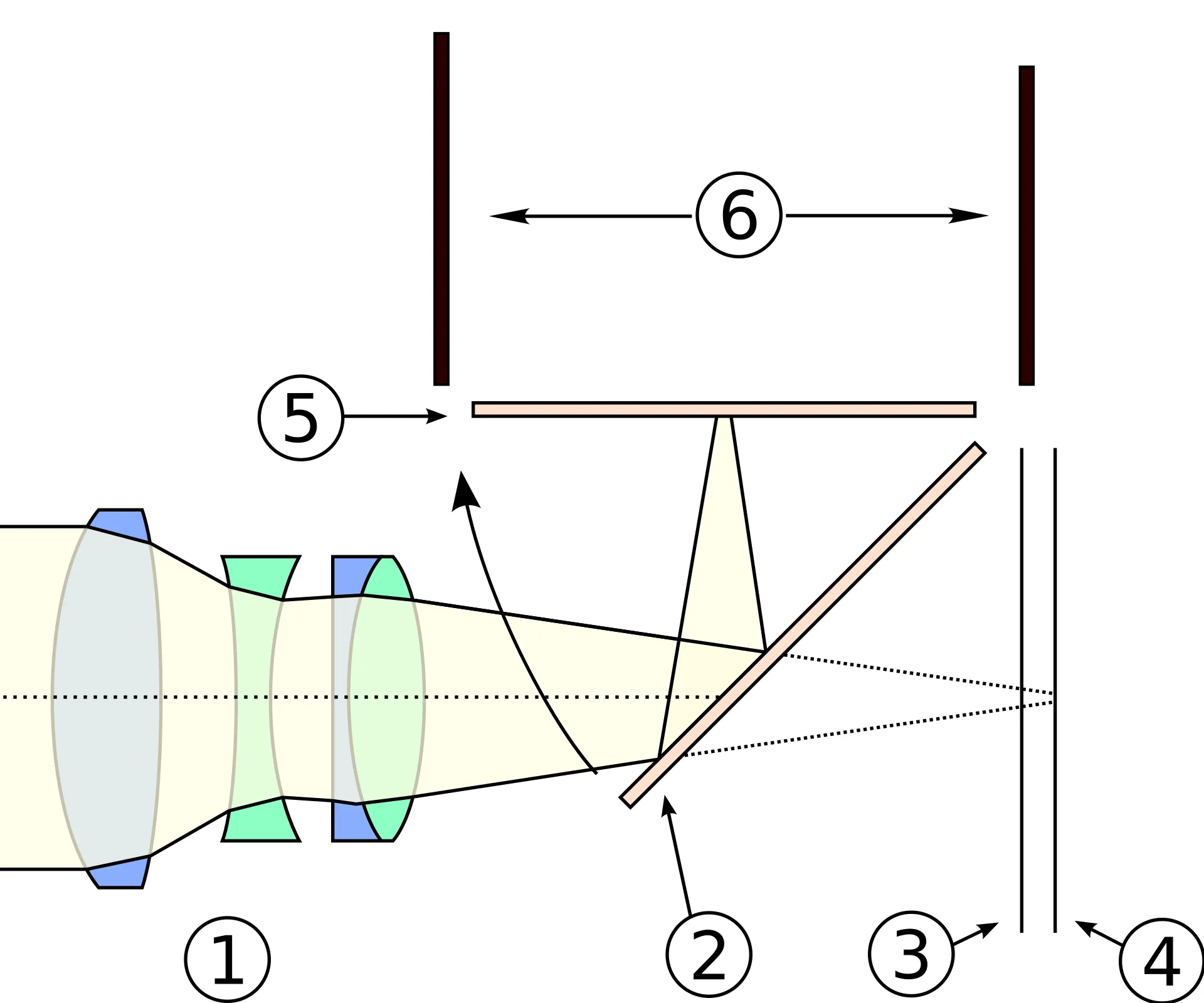
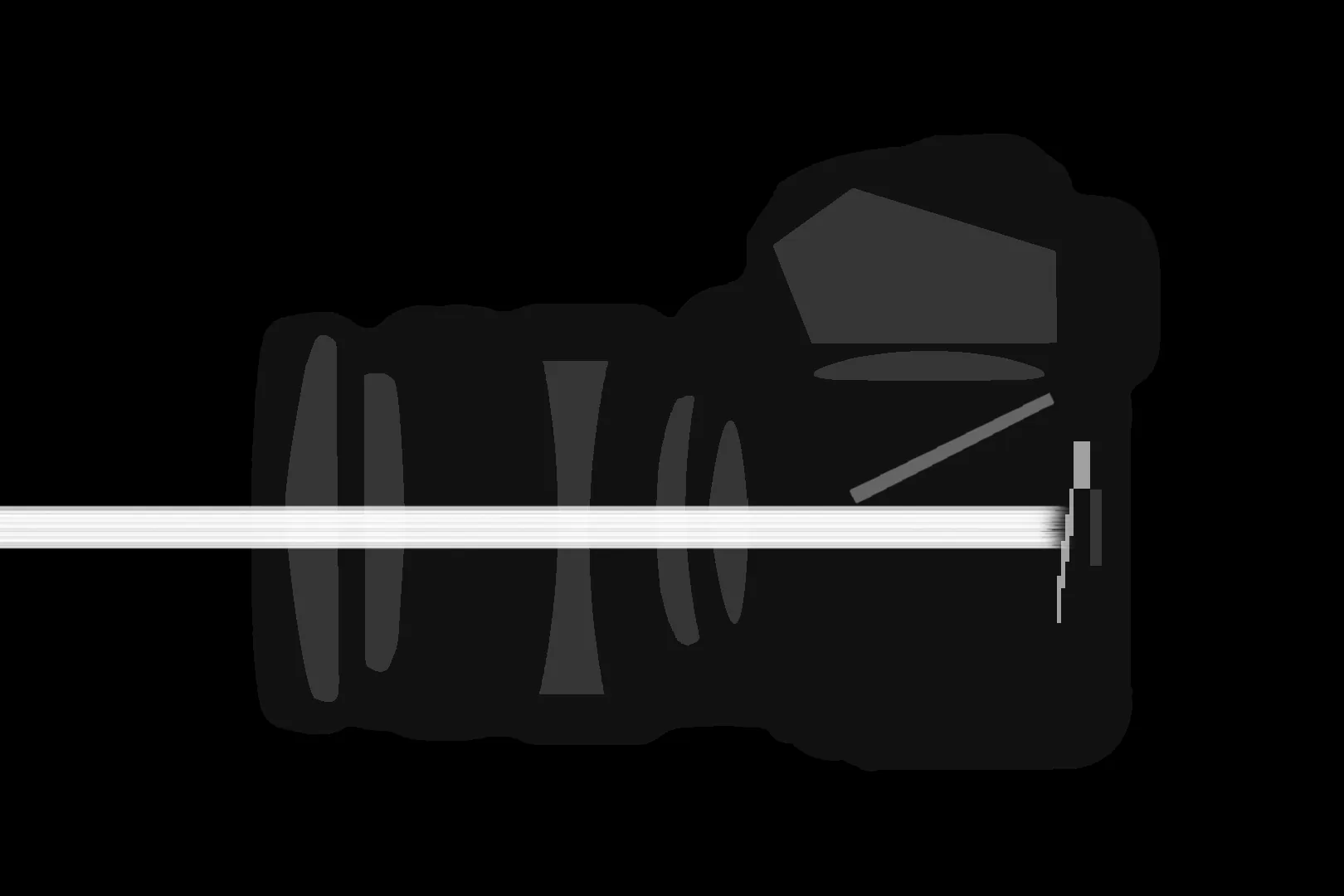
In a DSLR, light comes through the lens and hits an angled mirror. The mirror reflects it up onto a focusing screen and through a pentaprism (or, in cheaper bodies, a set of mirrors called a pentamirror) to the eyepiece. That is the optical viewfinder. When you press the shutter, the mirror flips up out of the way, the shutter opens, the sensor records the picture, and the mirror drops back down. That flip is the "clack" a DSLR makes.
How light travels in an SLR: through the lens, off the mirror and up through the prism to the eyepiece. Image: Bech via Wikimedia Commons, CC BY-SA 4.0 (rendered from SVG, resized)
Canon describes the difference simply: an SLR has a mirror that feeds an optical viewfinder, while a mirrorless camera has no mirror and shows the image on an electronic viewfinder. Everything else in this guide follows from that one change.
In a mirrorless camera, the sensor sits behind the lens with nothing in front of it except the shutter. It is always seeing the scene, so the camera can send that image straight to the rear screen and the electronic viewfinder (EVF). The same sensor also handles autofocus, metering and subject detection, because it is already looking at the picture.
The mirror also affects how a DSLR focuses. Part of the main mirror is semi-transparent, and a small secondary mirror behind it sends some of the light down to a dedicated autofocus sensor in the bottom of the camera. Canon's spec sheet for the EOS Rebel T7 describes exactly this: a "quick-return half mirror" and a separate phase-difference AF sensor. A mirrorless camera does not need that second sensor, because its focus points are built into the image sensor itself.
Viewfinder: optical vs electronic
This is the difference you notice first. Look through a DSLR and you see the real scene, through glass, with no delay and no screen. It uses no power, it never lags, and many photographers simply prefer it. Its limits are that it shows you the scene, not the photo. You don't see your exposure, white balance or picture style until you take the shot and check the rear screen. Lower-cost DSLRs also show a little less than the full frame: Canon lists the Rebel T7's pentamirror finder at about 95% coverage, so the edges of your photo can include things you didn't see.
An electronic viewfinder is a small screen you look into. Its big advantage is that it shows the picture you are about to take. Canon notes that with an EVF you can check color and exposure settings in the finder before you shoot. Turn the exposure compensation dial and the view gets brighter or darker. Switch to black and white and the finder goes monochrome. It can overlay a level, a histogram, focus peaking and zebras for video, and it can brighten a dark scene so you can still frame it.
The catch used to be lag, a low-resolution view and a blank-out between frames during bursts. Modern high-end EVFs have largely fixed that. Sony, for example, specifies blackout-free shooting for both the a7 V and the a1 II, so the view stays live while the camera fires. Cheaper mirrorless bodies still use smaller, lower-resolution finders, and every EVF uses battery power, which matters later in this guide.
Try both if you can. The viewfinder is a matter of taste more than a spec. Some people find an optical finder calm and natural; others never go back once they've seen exposure live in the EVF.
Autofocus
A DSLR focuses with its separate AF sensor when you use the optical viewfinder. That system can be very fast, and the best DSLRs were built around it for sport and wildlife. The Nikon D850 uses a 153-point system, and the Canon EOS 5D Mark IV has 61 points. The limits are that the points cluster around the middle of the frame, and that the AF sensor is a separate part, so its alignment with the image sensor can drift. Entry-level models have far fewer points: the Rebel T7 has 9.
A mirrorless camera focuses on the image sensor itself. That lets its focus points cover almost the whole frame, and because the camera is analyzing the actual picture, it can recognize what it is looking at. Current bodies detect people, eyes, animals, birds and vehicles, then follow them around the frame. The Canon EOS R10, an entry-level model, detects people, dogs, cats, birds and vehicles. Nikon rates the Z6III's autofocus down to -10 EV, which is very dim light.
DSLRs can focus on the sensor too, but only in Live View, with the mirror flipped up and the rear screen on. In most older DSLRs that mode was slower. The Nikon D780 is the exception: it borrows a 273-point on-sensor system from Nikon's mirrorless cameras for Live View. TechRadar calls it "effectively a hybrid of a full-frame DSLR and a mirrorless".
What this means in practice: for a moving child, a pet, or a bird against a busy background, subject detection on a modern mirrorless camera keeps more shots sharp with less effort. A skilled DSLR shooter can still do excellent work, but the camera is doing less of it for you.
Speed, shutters and silence
A DSLR has to move its mirror for every frame, which caps burst speed. The D850 shoots 7 frames per second, or 9 with its optional battery grip. Flagship sports DSLRs went faster, but always with that mirror slapping up and down.
Mirrorless cameras with fast "stacked" sensors can read the whole sensor electronically, so they don't need to move anything. The Canon EOS R5 Mark II shoots up to 30 fps. The Nikon Z8 has no mechanical shutter at all and offers 20 fps RAW bursts, plus high-speed capture modes up to 120 fps. Many mirrorless cameras also offer pre-capture, which records frames from just before you fully press the shutter, so you catch the moment a bird takes off even if you react a little late.
The electronic shutter is also silent. At a wedding ceremony, a concert or around wildlife, that matters. A DSLR can be quiet in Live View, as the D780 is with its 12 fps silent mode, but through the optical finder you will always hear the mirror.
The trade-off: cheaper sensors read out more slowly. On those cameras, a fast-moving subject can look bent or skewed in the electronic shutter, an effect called rolling shutter, so you may need the mechanical shutter for action.
Video
Video is where the gap is widest. To film, a DSLR has to lift its mirror and switch to Live View, which turns off the optical viewfinder and leaves you on the rear screen. Many DSLRs film at modest specs. The Rebel T7 records Full HD at up to 30p, not 4K, and the 5D Mark IV's 4K uses large Motion JPEG files.
Mirrorless cameras were designed around a live sensor feed, so video is a natural fit. You can frame through the EVF while filming, autofocus tracks faces on the sensor, and makers now put their best video features into mirrorless bodies. The R5 Mark II records 8K RAW internally. The Nikon ZR, a small cinema-style mirrorless body, records internal 6K RAW and 32-bit float audio.
Mirrorless bodies also more often have in-body image stabilization, which steadies handheld footage and stills with any lens. Nikon rates the Z f's at 8.0 stops. None of the DSLRs on our best DSLR list has it; they rely on stabilized lenses instead.
If video matters to you at all, mirrorless is the clear choice.
Battery life
Here the DSLR still wins, and by a lot. An optical viewfinder uses no power, so a DSLR only spends battery on focusing, metering and taking the picture. A mirrorless camera runs its sensor and a screen all the time it is on.
The standard CIPA ratings show the gap. The D850 is rated at about 1,840 shots per charge. The Nikon Z8, a 45.7MP mirrorless body, is rated at about 330 viewfinder shots. The D780 is rated at about 2,260 shots; the Canon 5D Mark IV at about 900.
CIPA numbers are conservative, and most people get more shots than the rating in real use, from either design. But the ratio holds. With a DSLR you can often shoot a whole trip on one battery. With most mirrorless cameras, you'll want a spare or two, or a camera that charges over USB-C.
Size, mounts and lenses
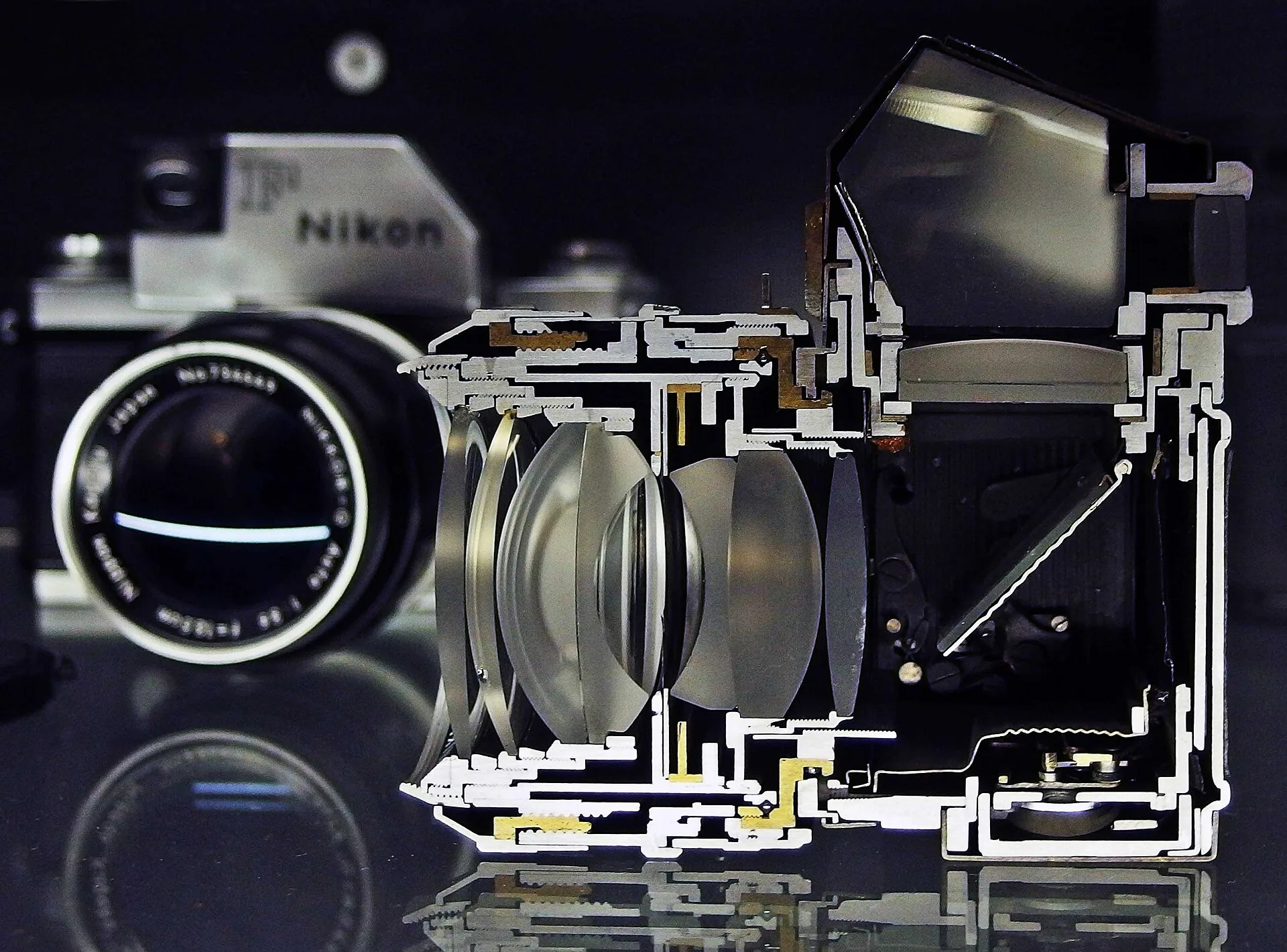
Taking out the mirror box frees up space between the lens mount and the sensor. That distance is called the flange distance. On Nikon's DSLR F mount it is 46.5mm; on Nikon's mirrorless Z mount it is just 16mm, with a wide 55mm opening. Canon's EF mount for DSLRs sits at 44mm, and its RF mount for mirrorless at 20mm. Nikon says the wide, short Z mount gives lens designers more freedom, especially for bright lenses and wide angles.
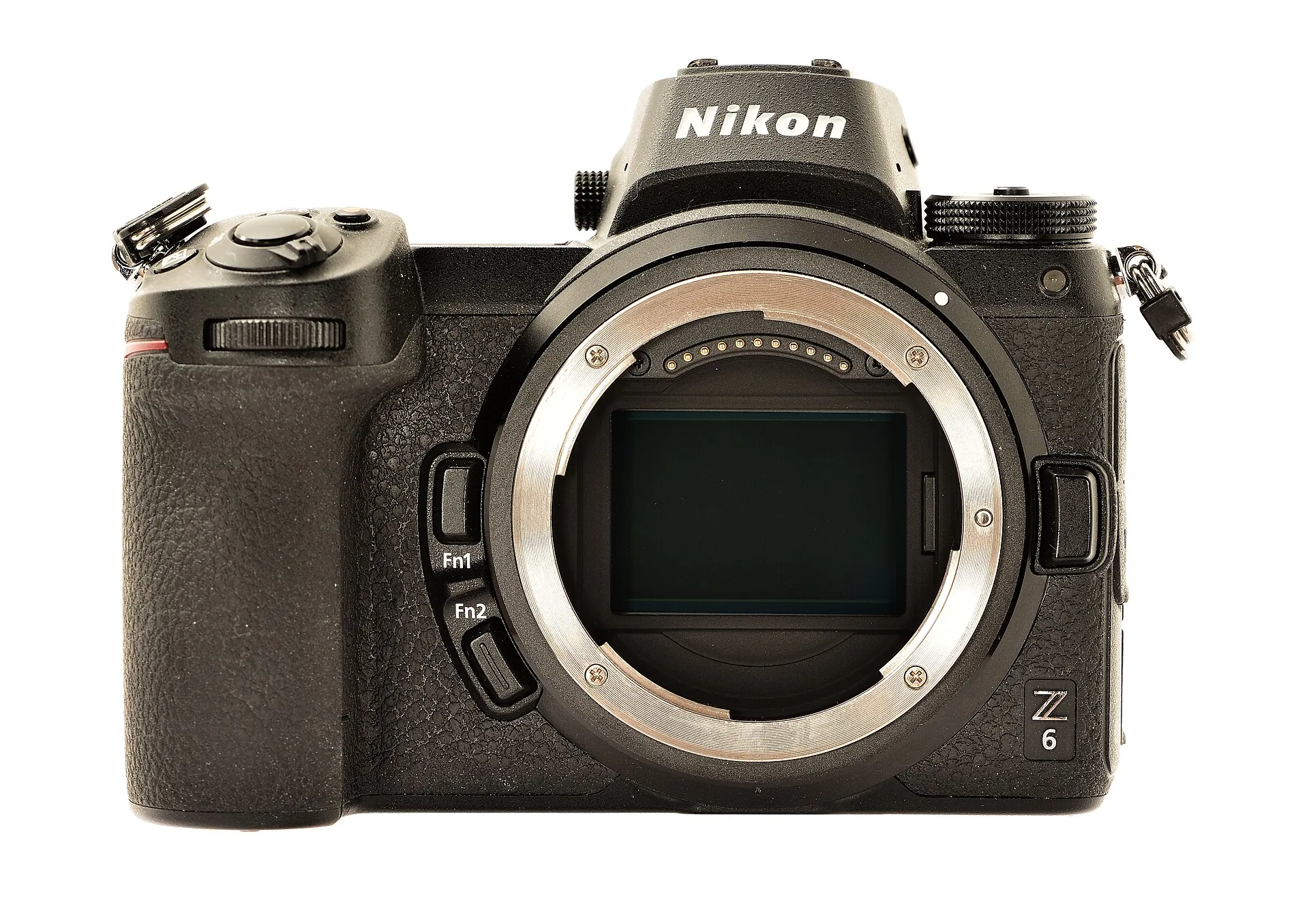
A cut-away Nikon SLR, showing the mirror box that sits between the lens and the film or sensor. Image: Martin Vorel via Wikimedia Commons, CC BY-SA 4.0 (resized)A Nikon Z6 with no lens fitted. With no mirror, the sensor sits just behind the wide Z mount. Image: Phiarc via Wikimedia Commons, CC BY-SA 4.0 (resized)
Does that make mirrorless cameras smaller? Often, but not always, and less than you might expect. The body can be thinner without a mirror box, but the sensor, grip, battery and controls still need room. A full-frame mirrorless body with a big grip can be about the size of a DSLR, and fast full-frame lenses are large on either system. The bigger savings tend to come in the smallest models. Canon lists the Rebel T7 at about 427 g body only, which is light for any camera, so a beginner DSLR is not necessarily heavy.
Your existing lenses still count. Both big makers sell adapters that let DSLR lenses work on their mirrorless cameras. Canon's Mount Adapter EF-EOS R fits EF and EF-S lenses to EOS R bodies, and Nikon's Mount Adapter FTZ II fits F-mount NIKKOR lenses to Z cameras. That means a move to mirrorless doesn't have to mean throwing out your glass.
New lenses are another matter. The new lens designs from Canon and Nikon are now for their mirrorless mounts. DSLR lenses are still sold, and the used market is huge, but don't expect many new ones.
Where the market is going
Camera makers have moved their development to mirrorless. Digital Camera World notes that Olympus, Fujifilm and Sony have phased out DSLRs, that Canon and Nikon have shelved DSLR development, and that the D6 was Nikon's last DSLR. Ricoh ended production of its current Pentax K-series DSLRs in September 2026, though it says a new SLR concept on the K mount is in development.
DSLRs are still sold new, but the list is short. Canon USA's own DSLR shop now lists only the 5D Mark IV and Rebel T7 configurations. TechRadar has narrowed its DSLR guide to models still available new, and some favorites, such as the Canon EOS 90D, are no longer listed as new at major US retailers.
That doesn't make a DSLR a bad camera. A D850 bought today will take the same superb pictures it did in 2017, and it will keep working for years. But if you're starting from scratch, you're buying into a system that is no longer getting new bodies, so think about where you want to be in five years.
Myths, quickly
"Mirrorless takes better pictures." Not because of the missing mirror. Image quality comes from the sensor, the lens, the processing and the light. A good DSLR and a good mirrorless camera with similar sensors produce similar files.
"DSLRs are obsolete." They're no longer being developed, which is different. A DSLR still works well, and its lenses work on mirrorless cameras with an adapter.
"Mirrorless is always smaller." Bodies are often slimmer, but lenses for the same sensor size are similar, and some mirrorless bodies are as big as DSLRs.
"Electronic viewfinders lag." Early ones did. Current high-end EVFs are fast and sharp, and some shoot without blackout. Budget ones are still less impressive.
"A DSLR is the cheap way in." Sometimes, especially used. But compare the whole kit, including lenses and spare batteries, against an entry-level mirrorless camera before deciding.
Which should you choose?
Your first camera
Mirrorless. Live exposure in the viewfinder makes it easier to learn, subject-detect autofocus helps from day one, and the system will keep getting new bodies and lenses.
You already own DSLR lenses
Either. Keep shooting your DSLR while it serves you, or move to the same maker's mirrorless body and use your lenses on an adapter.
Sport, wildlife and kids
Mirrorless, for faster bursts, pre-capture and subject tracking. A DSLR like the D850 still works if you know it well.
Video
Mirrorless. You can use the viewfinder while filming, track faces and get better codecs and stabilization.
Long trips away from power
A DSLR's battery life is a real advantage. With mirrorless, pack spares or a USB-C charger.
You love an optical finder
A DSLR is the only way to get one on a modern interchangeable-lens camera. That is a perfectly good reason to buy one.
Bottom line
The mirror is the whole story. Removing it let cameras show you the finished photo before you take it, focus on the sensor with subject detection, shoot faster and silently, and film properly. Keeping it gives you a clear optical view and far longer battery life.
For most people buying now, mirrorless is the better place to start, because that is where the new cameras, lenses and features are. A DSLR is still a fine choice if you own the lenses, love the optical finder, or find the right camera at the right price. Either way, the photos come from you far more than from the mirror.